
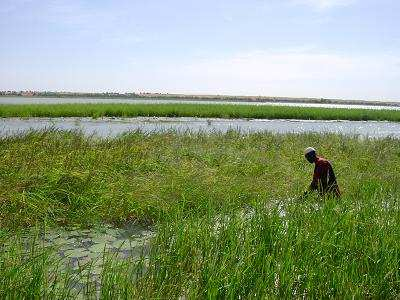
A wild grass and the ancestor of cultivated African rice, growing naturally in savanna water-holes and floodplains.
Wild rice (Oryza barthii, family Poaceae) is a clump-forming annual grass 60 to 150 cm tall, whose stems put out new roots at their lower joints. Its seed is sometimes gathered from the wild, though not often, because it is hard to harvest; it fetches a high price and is considered of unusually choice quality. The plant is not cultivated. Its most important use is probably in breeding: wild rices are a source of resistance to pests, diseases and harsh conditions for improving the cultivated rices, Asian rice (Oryza sativa) and African rice (Oryza glaberrima).
It grows across tropical Africa from Mauritania east to Ethiopia and south to Botswana and Zimbabwe, in shallow water in ponds, marshes and rice fields, up to 1,500 metres, often in pure stands. It needs an open, sunny place and prefers clay or black cotton soils. It can grow in deep water but does best in shallow water, and it is often regarded as a weed where it grows among rice. Fresh seed is usually strongly dormant, which suggests that it stays viable for a long time; alternating warm and cool temperatures help to break the dormancy.
Source: Useful Tropical Plants database (Fern, K.).
Seeds have been gathered by hand or from canoes in flooded ground for millennia, eaten as a grain especially in lean seasons.
Not cultivated in the usual sense — grows wild in seasonally flooded ground and is gathered rather than sown.