
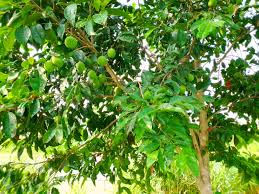
Irvingia gabonensis is a large, evergreen forest tree native to the humid lowland forests of West and Central Africa. It produces mango-like fruits with highly valued edible pulp and oil-rich seeds (kernels).
The dika nut or bush mango (Irvingia gabonensis, family Irvingiaceae) is a large evergreen tree with a dense, compact crown, 15 to 40 metres or more tall. Its trunk is generally straight, up to 100 cm across, with high buttresses that can reach 6 metres. It is a very important multi-purpose tree in Africa, and a person often claims the produce of a wild tree by farming around it or clearing the land beneath it. The seeds are an important local food and are often sold in markets, and in some areas, such as Benin, the tree is cultivated or semi-cultivated. Its numbers have fallen through logging, the spread of settlements and poor natural regeneration, and it is classed as Near Threatened on the IUCN Red List (2011).
It grows from Nigeria to the Central African Republic and south to Congo, DR Congo and Angola, in dense, moist lowland rainforest at 200 to 500 metres. It does best where daytime temperatures are 25 to 32°C and rainfall is 1,500 to 3,000 mm a year, in sun or light shade, on well-drained loamy to clayey soils. Young plants grow very slowly at first, then faster. The fruits are mostly gathered from the ground; each seed is split with a cutlass, and the kernel is taken out with a knife and dried in the sun or over the kitchen fire. Twelve-year-old trees in Nigeria have yielded about 1,060 fruits (180 kilos) each, though drier areas give much less. The trees do not resist fire, and the seed loses its viability quickly, so it is sown as soon as it is ripe.
Source: Useful Tropical Plants database (Fern, K.).
Various plant parts are used in African traditional medicine:
Bark: Decoctions are used for diarrhea, dysentery, gastrointestinal infections, yellow fever, and as an antidote to poisoning. Bark paste is applied to wounds and sores and used to relieve toothache.
Seeds: Used traditionally to manage diabetes and obesity by suppressing appetite.
Leaves: Used to treat fever and, when mixed with palm oil, to control hemorrhage in pregnant women.
Ogbono (Draw) Soup: Dried and ground kernels are used as a thickener and flavoring agent in traditional soups.
Dika Bread: Processed kernels are formed into solid cakes (also called odika or Gabon chocolate) for long-term storage.
Fruit Pulp: The sweet-tangy pulp is eaten fresh or processed into juice, jam, jelly, and wine.
Edible Oil: Oil extracted from the seeds (solid at room temperature) is used for cooking.
Snack Use: Seeds may be eaten raw or roasted.
Traditional Rituals: Bark and other plant parts are sometimes used for spiritual protection and treatment of spiritual ailments.
Cultural Significance: The tree is preserved on farms due to its importance as a staple food source, particularly for Ogbono soup.
Seed Propagation: Seeds are extracted from ripe fruits, dried for at least two days, and planted.
Seed Selection: Seeds are selected from high-yielding trees with large fruits and good pulp quality.
Vegetative Propagation: Budding, grafting, and marcotting (air-layering) are used to reduce the juvenile period, with fruiting in 3–4 years (compared to 7–10 years from seed).
Wildlings: Naturally occurring forest seedlings are commonly collected and transplanted to farms.