
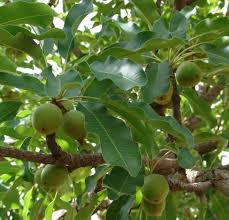
Vitellaria paradoxa is a large, slow-growing, drought-tolerant tree native to the sub-Saharan savanna. It produces edible fruits with fat-rich kernels used to make shea butter and is a keystone species in agroforestry and traditional African landscapes.
The shea tree (Vitellaria paradoxa, family Sapotaceae) is a deciduous tree usually 7 to 15 metres tall, occasionally 25 metres, with a dense, round crown and a short trunk 30 to 100 cm across. A reddish latex seeps from deep cuts in the bark. Its leaves are clustered at the ends of the branches, and it flowers in the early dry season. The plum-like fruit takes four to six months to ripen, mostly in the rainy season, and its nut holds the kernel from which shea butter is made. A good tree yields 15 to 30 kg of fruit a year.
Shea is characteristic of the West African savanna, ranging from Senegal to Sudan and Uganda in open parkland savanna, wild or kept on farmland, below about 600 metres. It is very slow to mature: trees first flower at 10 to 25 years, reach full production at 20 to 45 years and can live 200 to 300 years. The seed loses viability quickly and must be sown fresh. Grafting can bring trees into fruit much sooner.
Source: Useful Tropical Plants database (Fern, K.).
The tree is considered a “tree of life” with multiple therapeutic applications:
Bark: Decoctions used for diarrhea, dysentery, stomach aches, jaundice, eyewash, leprosy treatment, and as a bath to assist childbirth.
Leaves: Treat headaches, eye infections, and are used in vapor baths.
Roots: Used for digestive issues in humans and as veterinary medicine.
Shea Butter (Fat): Applied topically for rheumatism, joint and muscle pain, dermatitis, and wound or burn healing.
Latex: Used to treat sores.
Shea Butter / Cooking Oil: Extracted from nuts (kernels) and used as a dietary fat, cooking oil, and cocoa butter substitute in confectionery.
Fruit Pulp: Eaten raw; sweet and nutritious.
Flowers: Occasionally fried into fritters.
Caterpillars: The leaves host the caterpillar Cirina butyrospermi, which is eaten dried or fried.
Sacred Tree: Considered sacred in many communities; often protected from felling.
Ceremonial Uses: Shea butter is used in marriages, newborn blessings, and other rites symbolizing protection and prosperity.
Traditional Medicine & Spirituality: Employed by healers in rituals related to childbirth, lactation, and spiritual illnesses.
Seed Propagation: Traditional method; juvenile period is long (10–25 years).
Vegetative Propagation (Grafting): Side cleft grafting in May ensures faster fruiting (2–3 years) with up to 86% success.
Cuttings: Rejuvenated shoot cuttings treated with rooting hormone (IBA) can root with ~75% success.
Tissue Culture: In vitro micro-propagation is being developed for large-scale planting.