
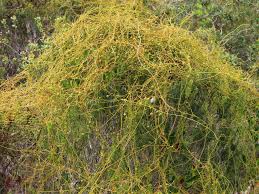
assytha filiformis, commonly called Love Vine or Dodder Laurel, is a parasitic vine widely found in tropical regions and known for its medicinal, ritual, and cosmetic uses in African traditional knowledge.
Love vine or dodder laurel (Cassytha filiformis, family Lauraceae) is a much-branched, twining, perennial parasite whose thin stems grow 3 to 8 metres long. It climbs over a host plant, feeding on it, and often forms dense mats that can kill the host. Its stems attach to the host with haustoria, small structures that penetrate the host and draw out water and nutrients. Green stems still contain chlorophyll and can make some of their own food, but stems that have turned yellow or orange depend entirely on the host.
The plant is widespread in the tropics from Africa through Asia to Australia, in thickets and open forest from sea level to 1,600 metres and especially on and behind sea shores, where it can blanket the scrub. Part of its success lies in how unfussy it is about hosts: botanists have recorded 42 host species in India, 36 species from 25 families in the Philippines and 81 species from 45 families in the Bahamas. It flowers and fruits throughout the year, its fruits are spread by sea currents and by birds, and its seed only germinates after being softened by microbes in the soil.
Source: Useful Tropical Plants database (Fern, K.).
It is traditionally used to treat urinary and reproductive conditions, skin and hair problems, fever, digestive disorders, and inflammation, though excessive use can be toxic.
Parts of the plant, including its small fruits and stem decoctions, are occasionally consumed as nutritional supplements or flavoring agents in traditional diets.
The vine is used in spiritual cleansing, hair cosmetics, natural dye production, traditional crafts, and as a natural pesticide or fish poison.
The plant is not intentionally cultivated and is usually controlled or removed due to its aggressive parasitic nature and potential harm to host plants.