
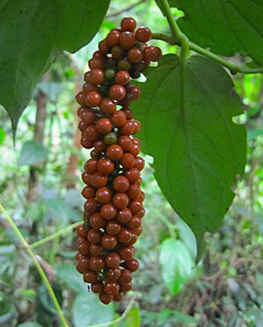
Piper guineense, known as African black pepper, Ashanti pepper, or Uziza (in Nigeria), is a West African spice used in cooking and traditional medicine for digestion, inflammation, postpartum recovery, libido, coughs, and antimicrobial effects, with its leaves and seeds rich in beneficial compounds like flavonoids and alkaloids.
Ashanti pepper (Piper guineense, family Piperaceae) is an evergreen climbing plant whose woody stems reach 4 to 20 metres, clinging to trees by roots that grow along the stem. Its small berries grow in clusters on slender stalks and are dried for use as a spice. Male and female flowers are borne on separate plants, so both are needed for fruit.
It is a plant of moist places: evergreen rainforest, forest edges and gallery forest along rivers, at 750 to 1,650 metres. Its range runs across tropical Africa from Senegal to southern Sudan and south to the Democratic Republic of Congo, Zambia and Tanzania. In savanna country it is found mainly in gallery forest and damp places along streams. It is grown from seed.
Source: Useful Tropical Plants database (Fern, K.).
Medicinal Uses & Properties
Digestive Health: Aids digestion, relieves flatulence, and treats intestinal issues like diarrhea and dysentery due to its astringent properties.
Anti-inflammatory: Helps reduce inflammation and is used for joint pains and rheumatism.
Reproductive Health: Used to enhance libido, support postpartum uterine contraction, and traditionally for fertility.
Respiratory: Used for coughs and bronchitis.
Antimicrobial: Possesses antibacterial properties and is used as a natural insecticide.
Antioxidant: Rich in antioxidants, protecting against oxidative damage.
Other Uses: Acts as an aphrodisiac, helps with weight loss, and is used in herbal concoctions (agbo).
How it's Used
The leaves and seeds are used fresh or dried, added to soups, stews, and pepper soup.
Crushed leaves and fruits are used to create non-toxic insecticides or body colognes.
Roots are chewed as an aphrodisiac.
Important Note
While beneficial in culinary amounts, excessive intake is cautioned, and its uterine-stimulating properties mean it's generally contraindicated during pregnancy.