
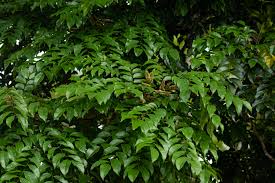
Erythrophleum suaveolens is a highly toxic African tree traditionally used in controlled medicinal practices but best known for its historical role in ordeal rituals and its potent poisonous properties.
The sasswood or ordeal tree (Erythrophleum suaveolens, family Fabaceae) is a tree up to 25 metres tall, occasionally 30 metres, with a trunk that often branches low down and is 60 to 90 cm across. Its wood is very durable and is commonly harvested for trade, and it is planted as an ornamental and avenue tree.
The tree is famous for its poison. Its bark contains alkaloids that, in high doses, act as an extremely strong and rapid heart poison, and the seeds are even more toxic. The bark has been used in arrow poisons and as an ordeal poison, which gives the tree its English names, and the bark and leaves have been used to poison fish; even the sawdust can irritate the airways of sawmill workers. It grows across tropical Africa from Sierra Leone to Sudan and south to DR Congo, Zimbabwe and Mozambique, in moist semi-deciduous forest, gallery forest and wooded grassland up to 1,100 metres, but not in evergreen forest. It regenerates best in fairly open forest, grows slowly in plantations, and, like many legumes, fixes nitrogen through bacteria in its roots. The seed germinates in about three weeks. The archive also lists this tree under the name Kor.
Source: Useful Tropical Plants database (Fern, K.).
In very small and carefully controlled doses, parts of the tree are used to treat pain, infections, rheumatism, and parasites, though internal use is extremely dangerous due to high toxicity.
The plant is not edible and is mainly associated with food-related practices only as a traditional fish poison.
Historically, the bark was used in ordeal trials to determine guilt, as well as for arrow poisons, insecticides, and protective applications.
The tree grows in savanna and forest zones, can be propagated by seed or cuttings, and is sometimes included in reforestation despite its slow growth and toxic nature.