
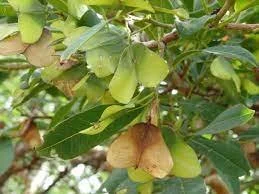
Hymenocardia acida is a deciduous savanna shrub or small tree of tropical Africa, notable for its sour leaves and bark and its wide application in traditional medicine. The plant is a small, often crooked tree with flaking bark exposing reddish inner layers, sour-tasting leaves, small unisexual flowers, and distinctive V-shaped winged fruits.
Heart-fruit (Hymenocardia acida, family Phyllanthaceae) is a deciduous shrub or tree up to 10 metres tall, often gnarled and twisted, with a stunted trunk up to 30 cm across. Its bark is rough and rusty red and yields a brownish-red dye. Male and female flowers grow on separate plants. Female plants bear flat, two-winged fruits whose shape gives the plant its English name.
It ranges across tropical Africa from Senegal to Ethiopia and south to Zimbabwe and Mozambique. It grows in deciduous woodland, grassland, riverine fringes and high-rainfall woodland, on sandy, loamy and clay soils, in areas with a long dry season, mostly at 500 to 1,200 metres. To raise it from seed, the wings are removed and the seed is soaked in cold water for 48 hours before sowing. It regrows well after cutting.
Source: Useful Tropical Plants database (Fern, K.).
The bark, roots, and leaves are extensively used to treat pain, fever, malaria, gastrointestinal disorders, respiratory infections, skin diseases, sickle cell anemia, and gynecological conditions
Young sour leaves are eaten as vegetables or condiments, while immature fruits are occasionally consumed, mainly by children.
The species has ritual significance for protection and hunting charms, and its bark, wood, and twigs are used for dyeing, tanning, construction, fuel, and oral hygiene.
Mostly wild-harvested, H. acida is fire-resistant and ecologically valuable for erosion control, shade provision, and pollinator support in savanna landscapes.