
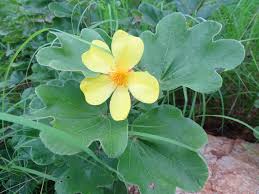
Cochlospermum planchonii is a perennial West African savanna shrub valued primarily for its medicinal roots and often confused with C. tinctorium, though it differs in growth form and flowering behavior. It is a low, bushy shrub with a woody underground rootstock, palmately lobed leaves, large bright yellow flowers, and capsular fruits typical of the genus.
False cotton (Cochlospermum planchonii, family Bixaceae) is a perennial with a woody underground rootstock. Each rainy season it sends up leafy shoots about 2 metres tall, which die back in the dry season. Its bright yellow flowers are borne near the base of the stems. It is followed by capsules whose seeds are packed in soft, cotton-like hairs, which give the plant its English name.
It is native to western tropical Africa, from Senegal and Sierra Leone east to Chad and northern Cameroon. It grows in savanna, in the forest–savanna mosaic and in hedges, from sea level to about 1,700 metres. Because its rootstock survives underground, it reappears each year after dry-season burning. It has been cultivated now and then in northern Nigeria for its seeds, and it is grown from seed.
Source: Useful Tropical Plants database (Fern, K.).
Root decoctions are extensively used to treat malaria, fever, gastrointestinal disorders, liver and infectious diseases, diabetes, pain, inflammation, and reproductive health conditions.
The roots serve as soup thickeners and colorants, produce yellow dye and ink, provide fiber and beads, and the plant is grazed by livestock in parts of the Sahel.
The plant features in traditional protective and spiritual practices, particularly among Fulani communities, where it is believed to confer metaphysical prot
Adapted to fire-prone savanna environments, C. planchonii is mostly wild-harvested, occasionally cultivated for seeds, and is increasingly vulnerable due to intensive root extraction.