
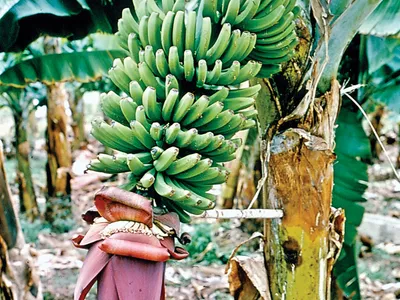
A large herbaceous perennial (3–9 m) with a succulent pseudostem, massive glossy leaves, pendulous inflorescences, elongated seedless fruits that ripen yellow and sweet, and reproduces via suckers.
The dessert banana belongs to Musa × paradisiaca (family Musaceae), the name botanists now use for the cultivated bananas and plantains; Musa sapientum, the name on this entry, is an older name for the sweet kinds. It is a large perennial about 8 metres tall that looks like a tree but is a herb: its top growth dies after flowering and is replaced by new shoots from the rootstock. The cultivated banana is a hybrid of two wild species, Musa acuminata and Musa balbisiana, and is known only in cultivation. Bananas are a staple food and among the most productive of all food crops, yielding more than cassava and several times as much as wheat or potatoes.
Of the very many varieties, two main kinds are distinguished: dessert bananas, which become very sweet when fully ripe, and plantains, which hold more starch and are usually cooked. The plant needs a sunny, sheltered place and well-drained, fertile soil with a pH of 6 to 7.5. Fruit does best at about 27°C, and if night temperatures fall much below 18°C while the fruit is ripening, its flavour suffers. It is normally propagated by carefully digging up and replanting the suckers that grow around the base.
Source: Useful Tropical Plants database (Fern, K.).
Unripe fruit and peel treat diarrhea and dysentery; leaves for wound dressing; flowers for diabetes; roots for urinary issues; stem juice for high blood pressure and snakebites; peel has antioxidant properties.
Ripe fruits eaten raw or in desserts; unripe fruits cooked or fried; banana flour used for thickening and digestion; leaves used for wrapping and steaming food.
Sacred in India and Southeast Asia; used in religious ceremonies, festivals, weddings, and offered to deities to symbolize fertility and prosperity.
Thrives in hot, humid tropics; propagated via suckers; planted 2–3 m apart; requires well-drained fertile soil, irrigation, and mulching; fruits in 9–10 months with ongoing production up to 20 years.