
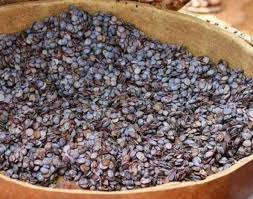
A strong, pungent traditional seasoning made from fermented locust beans. It is used in many Tiv soups and sauces to add a deep, savoury depth of flavour similar to umami. Also known as iru in other Nigerian culinary traditions.
Locust beans (fermented)
Locust beans are boiled, dehulled, fermented over several days, and then dried for storage and use as a flavouring agent.
Used as a key seasoning in soups and sauces, especially in Pocho, Atyever, and other traditional Tiv dishes.
One of the most important traditional flavouring agents in Tiv cuisine. Nune provides the distinctive depth and complexity of flavour found in authentic Tiv cooking. It is a pantry staple in Tiv households.
Nune comes from the African locust bean tree, Parkia biglobosa, which also appears in this archive's plant list. It is a deciduous tree 7 to 20 metres tall, occasionally 30, with an umbrella-shaped crown of heavy branches. It grows wild across western, central and northeastern tropical Africa and is often planted around villages and in farmland, where it shades the crops beneath. Its long brown pods, about 45 cm long, hold the seeds in a sweet yellow pulp that is eaten fresh, made into drinks or dried into flour.
According to the Useful Tropical Plants database, the seeds must be processed before eating because they contain antinutritional substances. Boiled and fermented, they become a black, strong-smelling, savoury food called dawadawa, rich in protein, fat and vitamin B2. Dried fermented seeds keep for more than a year in earthenware pots without refrigeration, and small amounts are crumbled into soups and stews eaten with sorghum or millet dumplings and porridges. Because of its savoury taste and high protein, it has been described as a meat or cheese substitute.
Akiga Sai, writing in 1935, mentions fermented locust-bean seeds cooked with palm oil and buffalo hide as part of the biamegh rites. He also records that the locust bean tree was one of the trees burned for ash in the old indigo dye pits.
Nune is also a soup in its own right. The Tiv food guide tivpeople.com describes nune soup as one of the easiest Tiv soups to make and one of the most delicious: palm oil, pepper, salt and water are brought to the boil and fresh locust beans are added, and the soup is ready. The same guide calls nune the one ingredient every authentic Tiv soup shares, and the base of nune soup, with beaten eggs added, makes aji a kesen, the Tiv egg soup. Daily Trust, reporting on Benue food sellers in 2021, found "locust bean (nune)" soup on their menus alongside ewedu, beniseed, okro and egusi.
Sources: tivpeople.com, "Tiv Food" (Internet Archive copy, 25 January 2025); Daily Trust, "An abundance of soups", 1 April 2021; Useful Tropical Plants database (Fern, K.); Akiga Sai, History of the Tiv (1935), translated by Harold M. Bergsma and Martin L. Akiga, Africa 85(4), 2015, chapters two and three.
Other Foods
See the Tiv people and the Tiv language in our Nigeria Heritage Archive: the states and local government areas where Tiv communities live, neighbouring peoples, population figures and sources.