
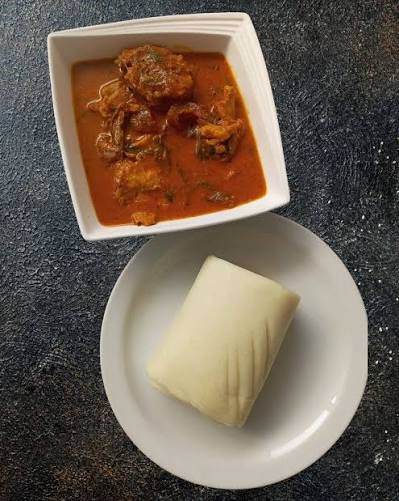
A light, watery sauce commonly prepared with smoked fish or meat, pepper, and locust beans (nune). It has a clear, thin consistency that complements the texture of pounded yam and other staples.
Smoked fish or meat, pepper, locust beans (nune), local seasoning
Smoked fish or meat is simmered with pepper, locust beans, and seasoning in water to produce a light, flavourful sauce.
Most commonly served with Ruam Kumen (pounded yam) and other staple foods.
A common and widely appreciated traditional sauce in Tiv cuisine, valued for its simplicity and the depth of flavour provided by locust beans.
Pocho is one of the everyday soups of Tivland. The Tiv food guide tivpeople.com describes it as a sauce of meat, onions, pepper, gbaaye (optional), palm oil, locust beans (nune) and salt, usually watery but just thick enough to coat the ruam when it is dipped; some people combine it with another soup, and it is also eaten with white rice or beans. Daily Trust, reporting in 2021 on food sellers in Benue, listed pocho among the soups indigenous to the Tiv alongside okro, ogbono, egusi and vegetable soups, and noted that sellers offer it either on its own or with fish, including "dry fish with pocho". The same report described the Tiv custom of serving a bowl of pounded yam with at least four different soups, especially to a visitor, with one usually a meat soup and the others made from vegetables in season.
Akiga Sai, writing in 1935, divides Tiv soups into two kinds. Bushi, ashwe and igar are non-viscous; any soup that is not sticky or slippery is called a "strong" soup. Okra and afialegh, by contrast, are viscous. He lists the old soup ingredients as squashes, sorrel and okra, with peppers, beniseed, melon seeds and ginger, most of them planted by women on the yam farms during the early rains, with pepper set in the shade. Of the two kinds of melon, the brown is used for soup, while the white is less oily and is eaten raw.
The locust beans (nune) that flavour pocho come from the African locust bean tree, Parkia biglobosa; see the Nune entry for how they are fermented.
Sources: tivpeople.com, "Tiv Food" (Internet Archive copy, 25 January 2025); Daily Trust, "An abundance of soups", 1 April 2021; Akiga Sai, History of the Tiv (1935), translated by Harold M. Bergsma and Martin L. Akiga, Africa 85(4), 2015, chapter two; Useful Tropical Plants database (Fern, K.).
Other Foods
See the Tiv people and the Tiv language in our Nigeria Heritage Archive: the states and local government areas where Tiv communities live, neighbouring peoples, population figures and sources.